

Who are we?
LUCÍA AND FRANCESCO
My name is Lucia, I am 22 years old and a qualified teacher from Valencia, Spain. I specialize in Therapeutic Pedagogy, and I came here to develop enriching educational projects that can make a positive impact on students’ learning experiences. Besides teaching, I love music and I play the clarinet. I enjoy bringing creativity and fun into learning, and I hope to share this passion with the students here.
Hello, I’m Francesco, I am 23 years old and a psychologist graduated from an Italian university. I joined this project because I wanted to contribute to meaningful educational initiatives and gain international experience in education. In my free time, I enjoy sports and outdoor activities, and I love finding creative ways to engage with people and build strong connections.
We met here in Poland and quickly realized that we share very similar views on education. We both believe in inclusive, student-centered learning and in creating environments where every student feels supported, motivated, and inspired.
Together, we are committed to working as a team, combining our skills in pedagogy, psychology, and creativity to design engaging and impactful learning experiences. We hope to inspire the students and the school community while also learning from this incredible cultural and educational experience.


WELCOME
Welcome to our blog! Through this space we want to share our experience and the activities we carried out during our ESC (European Solidarity Corps) volunteering in Primary School No. 24 in Białystok.
The European Solidarity Corps is an EU-funded programme that gives young people the opportunity to volunteer in another country, support local communities, and promote cultural exchange while gaining new skills and experiences.
We have been here from the 15th of September until the beginning of the Christmas holidays.
We arrived full of enthusiasm and excitement: ready to share parts of our cultures, practise some English with the children, and discover how the educational system works in a different country. Our main workspace was the świetlica, but we also had the chance to lead projects with older students and even spend time in a few other schools.
From the very first days, we felt warmly welcomed—both by teachers and staff, and by the pupils, many of whom had already met international volunteers in previous years. We knew that not everyone, especially the youngest children, would speak English fluently, but we quickly realised that their enthusiasm to communicate, play, and interact with us was much stronger than any language barrier.

PROJECTS
During this 3 months, we had completed 18 activities/projects

our countries' presentation
Where we prepared presentations, songs, games, and a memory activity to help others understand where our hometown is located. We also worked on maps of Spain and Italy and learned about the flags of each country. This project helped to improve my communication, creativity, and teamwork skills.

Culture and traditions
Where we recreated important buildings using construction materials, explored local culture by making masks, learning dances, and observing traditional foods. This allowed to understand the history and traditions of both countries while fostering creativity and collaboration.

We are going to travel together
The final project began with creating our own passports, which allowed us to “travel” during the program. We decided to create a travel-themed environment so that we could explore countries together with the children from Swilitza.

First days
16th September
From the very first days, we felt warmly welcomed—both by teachers and staff, and by the pupils, many of whom had already met international volunteers in previous years. We knew that not everyone, especially the youngest children, would speak English fluently, but we quickly realised that their enthusiasm to communicate, play, and interact with us was much stronger than any language barrier.
Thanks to the help of the teachers, we were able to get a first idea of what the świetlica kids knew about our countries… and the answer was: not much! A few had visited during their summer holidays, mostly to enjoy the beaches, but the thing everyone mentioned—and with great enthusiasm—was the food. Especially pizza! We spent the first few days focusing on getting to know the children, mainly through small conversations—often non-verbal ones, considering our almost complete lack of Polish. We quickly realised that the best way to connect was through play, so we spent a lot of time with them around games like UNO, Dobble, Monopoly, and many others.
After a few days of understanding how the school works, getting familiar with the timetable, and especially getting to know the kids, we decided it was time to share a little bit about ourselves and our cultures. We prepared a presentation—mainly using photos and videos to overcome the language barrier—showing important cities, culturally relevant events, and of course, famous foods.
We finished the presentation by teaching a few simple phrases, such as how to say hello, goodbye, and how to ask us to play in our own languages. The kids seemed really interested, both in the presentation and in learning those new expressions.

Present ourself to the rest of the school
Shortly after the presentation in the świetlica, some teachers asked us to prepare similar presentations about our countries and languages for the older students, because the school was preparing for the upcoming International Language Day. This time we were able to use more English, but the main focus was on Spanish and Italian. We explained a few grammatical differences from Polish, highlighted the many similarities between our two Latin languages, and played some language-based games and challenges using common words and phrases.
We ended the session with a couple of tongue twisters in our languages, which the students were surprisingly good at. Then they asked us to try some Polish tongue twisters… and we quickly realised we were not nearly as skilled as they were with ours!
Overall, most students seemed genuinely interested in both the languages and the cultural part of the presentation—especially because many of them already knew a few things, or even a few words, about Italy and Spain.


After the presentation, we created two posters together with the świetlica kids—one about Spain and one about Italy. After drawing and colouring the names of the countries, the children added drawings of typical objects and foods from each place. Then came the most creative part: painting the flags using our hands—literally! The kids were incredibly hyped to do this. They dipped their hands in paint and pressed them onto the posters, following the colours and patterns of each flag.
They seemed very proud of the final result, often placing their hands on the now dried paint to show their friends exactly where their handprint was and how they helped make the poster.


PROJECT: MASK OF VENICE
"Have you ever wondered what it feels like to bring the magic of Venice’s Carnival to life with your own hands?"

For this project, we focused entirely on Venice and its world-famous Carnival, one of Italy’s most iconic celebrations. The Carnival of Venice is known for its elaborate masks, vibrant costumes, and lively music, creating a magical atmosphere that attracts visitors from all over the world. Through interactive videos, we showed the children what happens during the Carnival—the parades, the dances, the music, and the beautifully decorated masks worn by everyone attending.
We set up a creative workspace full of materials, including pencils, paints, glitter, feathers, and stickers, so the children could bring their own Venetian masks to life. Over several days, they designed and decorated their masks, inspired by the carnival’s colors, patterns, and festive energy. To make the experience even more immersive, we played authentic Carnival music in the background, allowing them to feel the rhythm of Venice as they worked.
The children had complete freedom to express themselves, and the results were amazing. Some masks were displayed on a large poster for the entire school, while others were taken home to share with family. The kids loved the project so much that many asked to create more masks even after the activity had ended!
This project was not only a fun and creative experience but also a wonderful way to introduce the children to Venetian culture, the history of the Carnival, and the joy of artistic expression.


PROJECT: PISA
"Have you ever tried to ‘hold up’ the Leaning Tower of Pisa with your imagination?"


For the Pisa project, we focused on the city’s most iconic monument: the Tower of Pisa (Torre di Pisa). We started by showing the children what the tower looks like and explaining its famous tilt. We also introduced the classic tourist photo pose, where people use perspective to make it look as if they are holding up the leaning tower.
After this introduction, we asked the children to create their own drawings of themselves in that pose. They worked with creativity and imagination, drawing themselves as if they were interacting with the tower.
Once finished, we displayed their artwork in the school hall, right next to the Venetian masks from the previous project.
The children had a fantastic time expressing themselves through this activity. Not only did it teach them about one of Italy’s most famous landmarks, but it also encouraged creativity, reflection, and a playful approach to learning about different cultures.
Project: FALLAS
. . .
"Have you ever imagined celebrating a festival with colourful art, music, and the spirit of fire?"

Next, we “traveled” virtually to Spain to explore the Fallas of Valencia, one of the country’s most famous and vibrant festivals. We introduced the children to typical festival words, explained the main events such as la plantà (the building of the Fallas figures) and la cremà (their burning), and discussed the cultural meaning behind this colourful celebration.
With traditional Valencian music playing in the background, the children painted figures of falleras and falleros, immersing themselves in the festival’s lively spirit. Together, we created a large, bright mural that captured the energy, creativity, and joy of the Fallas, which was then proudly displayed in the school hallway.
The children absolutely loved the colours, the music, and the idea of celebrating through art and creativity. This project was a fantastic way to introduce them to Valencian culture while encouraging teamwork, imagination, and hands-on learning.


PROJECT:
SOROLLA AND PICASSO
Have you ever wondered what it feels like to step into the world of famous painters and create your own masterpieces?
Next, we decided it was time to introduce the children to two of the most important Spanish artists: Picasso and Sorolla. We started by explaining a little about who they were and showing some of their most famous works. Then we chose a Picasso painting and asked the kids to colour it in a creative and personal way—which they did with great enthusiasm.
On another day, we showed them a well-known Sorolla painting, but this time we asked the children to paint it while trying to stay as close as possible to the original. They enjoyed both activities, and we later displayed their creations on another poster for the whole school to see.
At the end, we displayed all of their creations on a large poster for the whole school to see. The children were extremely proud of their work, and it was wonderful to see how much joy and creativity the project inspired. This experience not only taught them about Spanish art and famous painters but also encouraged artistic expression, attention to detail, and confidence in their own abilities.


NEXT PROJECT
- European Day-
On European Day, we had the opportunity to present our projects and experiences to other schools. We prepared presentations showcasing all the activities we had done, from cultural projects to creative workshops, and shared them with students and teachers from different schools.
Moreover, we met with the members of the European Club, where we talked about our experience as volunteers and explained the values and opportunities offered by the Erasmus+ program. This exchange was inspiring and highly interactive, allowing us to promote intercultural dialogue, highlight the importance of European collaboration, and motivate others to take part in future European projects.
It was an enriching experience for everyone involved: the children and students got to see what can be achieved through creativity and cultural exploration, while we had the chance to reflect on our journey and share the excitement of learning about Europe in a hands-on way.

PROJECT: ROAD SAFETY
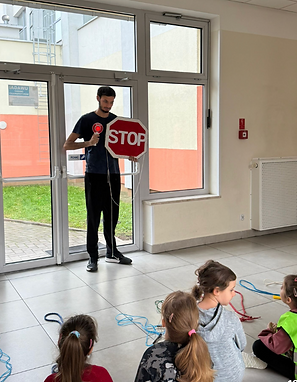
One of the activities we did with the świetlica kids was a lesson on road safety. We used paper to create a small zebra crossing, red and green papers to represent a traffic light, and made some simple road signs out of paper. Using these objects, we were able to simulate important situations that can occur on the road, such as crossing the street, stopping at a light, or recognising traffic signs.
During the activity, we explained how to behave safely in each situation, emphasising rules like looking both ways before crossing, waiting for the green light, and paying attention to cars and bicycles. The children really enjoyed this hands-on approach, as it let them actively practice the rules instead of just listening. We could see that they were engaged and taking the lesson seriously, while also having fun and experimenting with the mini road setup. By the end, they seemed much more aware of how to behave safely when they are out and about.

PROJECT: Cooking classes
The cooking class is held weekly at the school, and we had the wonderful opportunity to join several of these sessions. During one of them, we introduced the students to a traditional Valencian cake called Coca de llanda, explaining a little about its history and why it is so popular in Valencia.
We baked several cakes together with the students, guiding them step by step through the process and encouraging them to take part in every stage, from measuring ingredients to mixing the batter. It was a hands-on activity that allowed the children to learn practical cooking skills while having fun. Once the cakes were ready, each student was able to bring home their own creation, proudly showing their families what they had made.
To ensure they could recreate the experience at home, we also provided them with a written copy of the recipe, along with some tips and tricks we had learned while preparing it. This way, the students could try baking the Coca de llanda on their own, helping them gain independence in the kitchen and reinforcing the cultural connection to Valencia. Overall, the session was very engaging, and the students were enthusiastic, proud, and eager to share their results.


PROJECT: GYM
“Traditional Games Across Generations”

For this project, we collaborated with the school’s physical education teacher, Beata, to organize gymnastics and sports activities with three different student groups. Our goal was to go beyond the classroom we were assigned and create an inclusive experience that involved students of different ages.
We focused on traditional games and sports from our home countries—Spain and Italy—introducing games that are typical in our regions but less familiar to the children. The older students, in particular, had the opportunity to try activities they had never played before, combining fun, teamwork, and cultural learning.
Through these sessions, the children not only practiced physical skills and coordination but also learned about the cultural background of each game. The project encouraged interaction between different age groups, promoted physical activity, and highlighted the importance of sharing cultural traditions through sports.
The students loved the activities, showing great enthusiasm and creativity while playing, and it was incredibly rewarding to see how traditional games can connect people and create a sense of community across generations.
It was so fun!

PROJECT: Travel around Italy and Spain, are you ready?

For our final project as volunteers, we wanted to do something unforgettable — something that would open the children’s minds, spark their curiosity, and let them explore the world through imagination.
So we asked the big question:
“Are you ready to travel with us?”
The children shouted YES, and our adventure began.
Before beginning, we explained what passports are, why they are necessary, and what it means to cross a border, and each child created a personalized passport with their name, photo, nationality, and decorations. Once our documents were ready, we chose our travel route together and decided to visit Madrid, Rome, and Seville.
Our adventure began in Madrid, where we spent one week discovering the city: we learned what a subway is, why big cities depend on it, how to read metro lines, and as a final project the children created their own colorful and creative metro maps. We also explored Madrid’s culture through its food, music, and celebrations like San Isidro.
67
After that, we “flew” to Rome and stepped into the world of the ancient Romans. We learned who the Romans were, studied their architecture, legends, numerals, and clothing, and discovered the importance of the Colosseum. The children then created beautiful collages representing the Colosseum using textures, recycled materials, and their own imagination.
Our final destination was Seville, a city full of color, tradition, and rhythm. We learned where it is located, explored its Andalusian identity, listened to flamenco music, and even practiced dancing sevillanas. Inspired by local culture, the children designed their own colorful abanicos (fans), each reflecting their personal style. Throughout this journey, the children developed curiosity, creativity, teamwork, and cultural awareness, transforming this project into a meaningful and joyful ending to our experience as volunteers, filled with learning, imagination, and unforgettable moments.
And the final mural for our travel was...
Soy un párrafo. Haz clic aquí para agregar tu propio texto y edítame. Es muy sencillo.


Merry Christmas
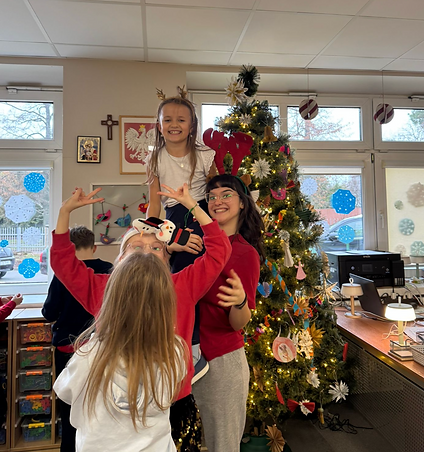
This week, to close our volunteer project with warmth and joy, we also wanted to wish everyone a very Merry Christmas, so we created festive crafts to hang on the window: Christmas stockings where the children wrote or drew what they hope Santa Claus will bring them. We also talked about how Christmas is celebrated in our own hometowns, comparing traditions, food, lights, and customs, making this final week both meaningful and magical. Throughout the entire journey, the children developed curiosity, creativity, teamwork, and cultural awareness, turning this project into a joyful and unforgettable ending to our time as volunteers.




THANKS FOR EVERYTHING

From Lucía and Francesco, we want to express our deepest gratitude.
First of all, thanks to all the teachers in Swietlica — Ewa, Karolina, Joanna, Monika, and especially Agnieszka, who was always there to help us, to organize the children, and to make everything possible with her constant support. Thanks to them, we were able to carry out every project with freedom, creativity, and enthusiasm.
Thank you also to Beata and Katarzyna for supporting and guide us during all these months.
Thanks to Ryszard for always providing the panels for our activities and doing everything with a smile.
We are equally grateful to the wonderful cookers, who prepared delicious meals every day and treated us with such kindness.
Thanks to all the teachers who invited us into their classrooms to introduce ourselves and share a session with their students.
It has been an absolute pleasure to bring and leave a little piece of Spain and Italy here with all of you.
And finally, our most heartfelt thanks go to the children, who we will carry in our hearts for many years.
Thank you for welcoming us, for loving us, and for filling our days with joy.
We wish you all a Merry Christmas and a school year full of excitement, curiosity, and beautiful moments.
Thank you.
Lucia and Francesco